Alcony is not a to-do app and not a prediction market. It's a place to think through
real decisions using the best of decision science (which involves lots of maths). Think
a trade you're watching, a job change, a big purchase: by unpacking the paths you're
weighing and the specific uncertainties, you can track the nuance and the changing
environment for the right (probabilistic) time to act.
The app puts you into a structured decision-making framework, ensuring you're using
best practices from decades of decision science. The fundamental building block is
borrowed from professional forecasters — the forecasting question: instead of one
gut-feel answer ("I think I should stay"), you break the decision into specific,
checkable questions ("Will I get a promising interview in 60 days?"), make an actual
prediction on each, and revisit it as evidence comes in. That turns a vague worry into
something you can watch get clearer over time.
What brings it all together is the Landscape. The Landscape lets you see these
forecasting questions across time, linked to the action paths you can take.
Probabilities, AI, and all the maths are built in for you, so all you have to focus on
is seeing the big picture.
Landscape
The whole situation you are trying to understand.
Question
One specific thing you are unsure about inside that situation.
Prediction
Your current best guess on a question — yours, an AI Analyst's, or a friend's.
Outcome
What actually happened, once you know it.
Why the Balcony?
The name comes from a saying we used in business whenever we were stuck in the weeds:
"Let's get up on the balcony!" Three things Alcony is fixing, in order:
A pile of advice and analytics isn't a decision
Notes, research, dashboards, and conversations pile up but don't show you how the
situation is actually developing. They're inputs, and should be treated that way.
The hard part is how the pieces connect
Whether you should act depends on several uncertainties moving together, not any
one in isolation.
Decisions get better with feedback
Making an actual prediction — and checking it later against what happened — teaches
you more than a single conversation ever will. We believe in continuous improvement.
Purpose of a Landscape
A landscape is the container for one real situation: it holds the paths you might take
(action paths), the events and inputs you need to track (questions), and anything
you've learned along the way (evidence, including documents). You don't need to fill
all of it in before it's useful — most people start with one question and grow into a
full landscape.
See the action paths
Name the routes you might take, such as stay, search, renew, negotiate, prepare, or
pause.
See the uncertainties
Turn the unknowns into forecasting questions you can watch, predict on, and resolve
later.
See the relationships
Connect evidence to action paths so you can tell what would make each path more or
less attractive.
What Is a Landscape?
Scope
The one-line name for the terrain you're watching, e.g. "Career move."
Action Paths
The routes you're weighing: stay, search, renew, negotiate, prepare, pause.
Questions
The specific uncertainties that, if you knew them, would tell you which path
makes sense.
Predictions
Your current estimate on each question — including AI Analysts and anyone you
invite to contribute.
Evidence
The information relevant to the predictions.
How Forecasting Fits
Two entry points, same underlying tool:
Start with a landscape
When your situation sounds broad, with several moving parts.
Should I hold, add to, or exit this position?
Should I stay at my job or look for something else?
Should I move, renew my lease, or negotiate?
Start with a single question
When you already have one narrow, resolvable uncertainty.
Will this stock trade above $150 by Friday?
Will I hear back from this job by Friday?
Will my rent increase by more than 5% at renewal?
Either way you end up with questions you can predict on and revisit —
a landscape is just several of them tracked together with the paths and evidence that
connect them.
Create a Landscape
Goal: turn a messy situation into a working landscape in a few minutes.
From the Dashboard, click New Landscape.
You'll land on a blank prompt: "What's on your mind?" Type the situation in your own
words — messy is fine. Click Tell Alcony.
Alcony may ask a few follow-up questions, then proposes a scope. It prompts you
through the rest of the components: a set of action paths, a first round of
forecasting questions as editable cards, and a way to link the questions and actions.
Keep what's useful, edit or delete what isn't, then confirm to automatically create the landscape.
It's quick and everything can be modified later, so just brainstorm away freely —
getting started is the most important step.
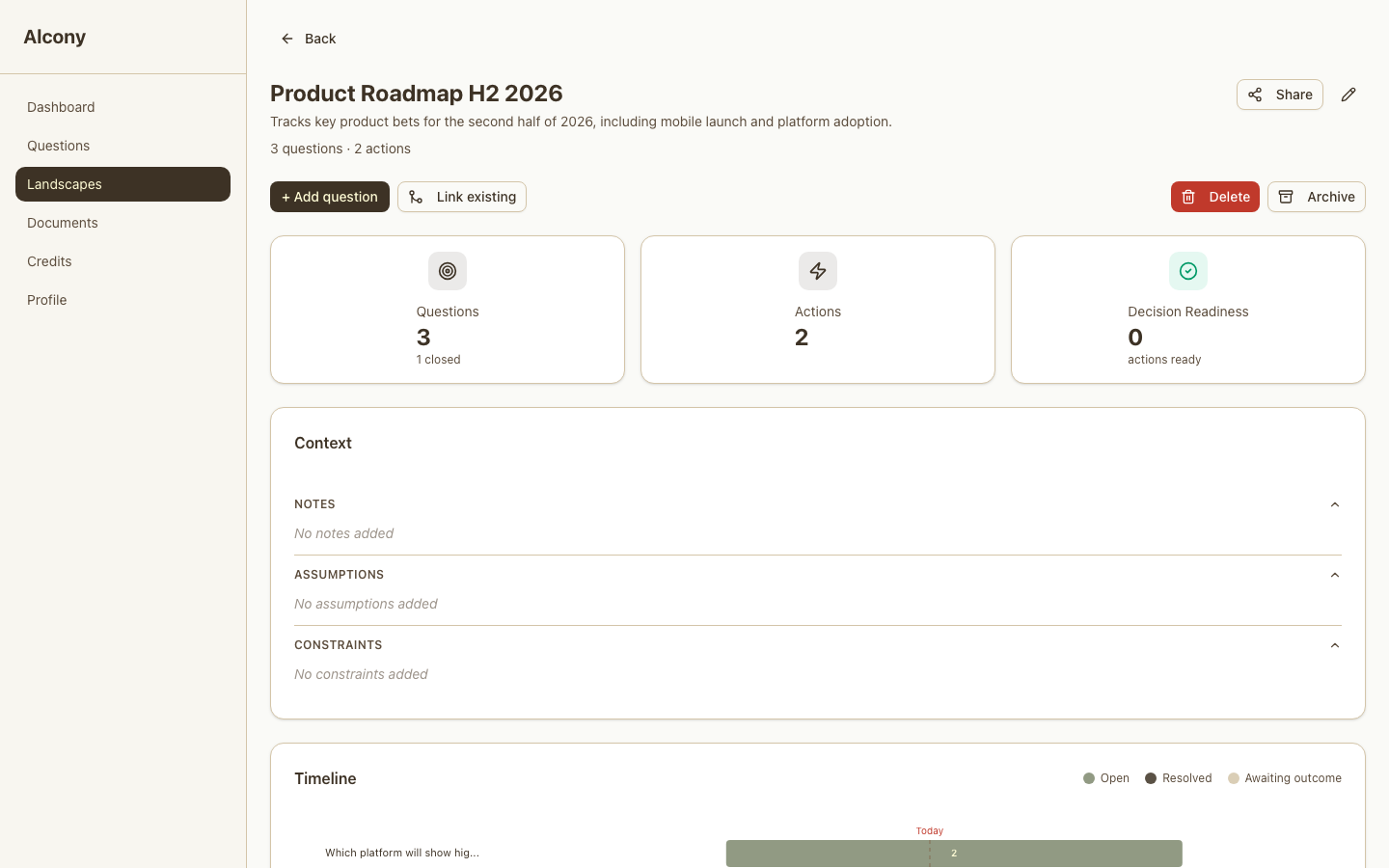
Once created, the landscape detail page shows three stat boxes (Questions, Actions,
Decision Readiness), a Context panel (Notes / Assumptions / Constraints — collapsible,
empty until you fill it in), and a Timeline of your questions colored by Open /
Resolved / Awaiting outcome.
Questions, Actions, and Decision Readiness at a glance, with a Context panel and Timeline below.
You can add questions to an existing landscape later with + Add question,
or attach a question you already created elsewhere with Link existing.
Read the Action Trigger Matrix
Goal: see which action path is actually ready, and what's still missing.
Every landscape has an Action Trigger Matrix — a grid with your forecasting questions
down the side and your action paths across the top. Each cell answers one thing:
what does this question need to show for this action path to make sense?
It's the piece that turns a pile of forecasts into a "so what do I actually do."
Reading a cell
Green — the trigger condition is already met.
Dark orange — informed, and the forecast is trending toward the trigger (probable).
Light orange — linked and informed, but not close yet.
Tan — linked, but no predictions yet, so there's nothing to judge.
Hover any filled cell for the question text, the exact trigger — a threshold for
number questions, an answer for yes/no, an option for multiple choice — and the
current urgency. Each action path column also shows a small readiness gauge: an
overall read on how close that path is to being triggered, across every question
linked to it.
Editing the matrix
Click the pencil icon to enter edit mode (requires ownership on the landscape).
Click any cell to open the link dialog. For number questions, set a threshold and
direction (e.g. "greater than 5,000"); for yes/no or multiple choice, pick which
answer point is relevant to the action. For example, "When CPI rises above 3% it is relevant to my action to sell."
Add a new action path with the button at the bottom of the matrix. Remove an action
path or a question with the × above its column or row.
Warning: removing either one breaks all the links and thresholds
you've set for it.
This is where the landscape earns its name. Questions alone tell you
what's uncertain; the matrix tells you which uncertainty actually changes what you'd do.
Create and Track a Question
Goal: turn one uncertainty into something you can predict on and revisit.
From Questions, click New Question (or + Add question from inside a landscape).
Type a rough version of the question. Alcony suggests the question type (yes/no,
multiple choice, or a number), an end date, units, and categories — all editable.
Create is disabled until the question validates (it needs a clear end
date and, for number/category types, units or categories filled in).
Reading a question card
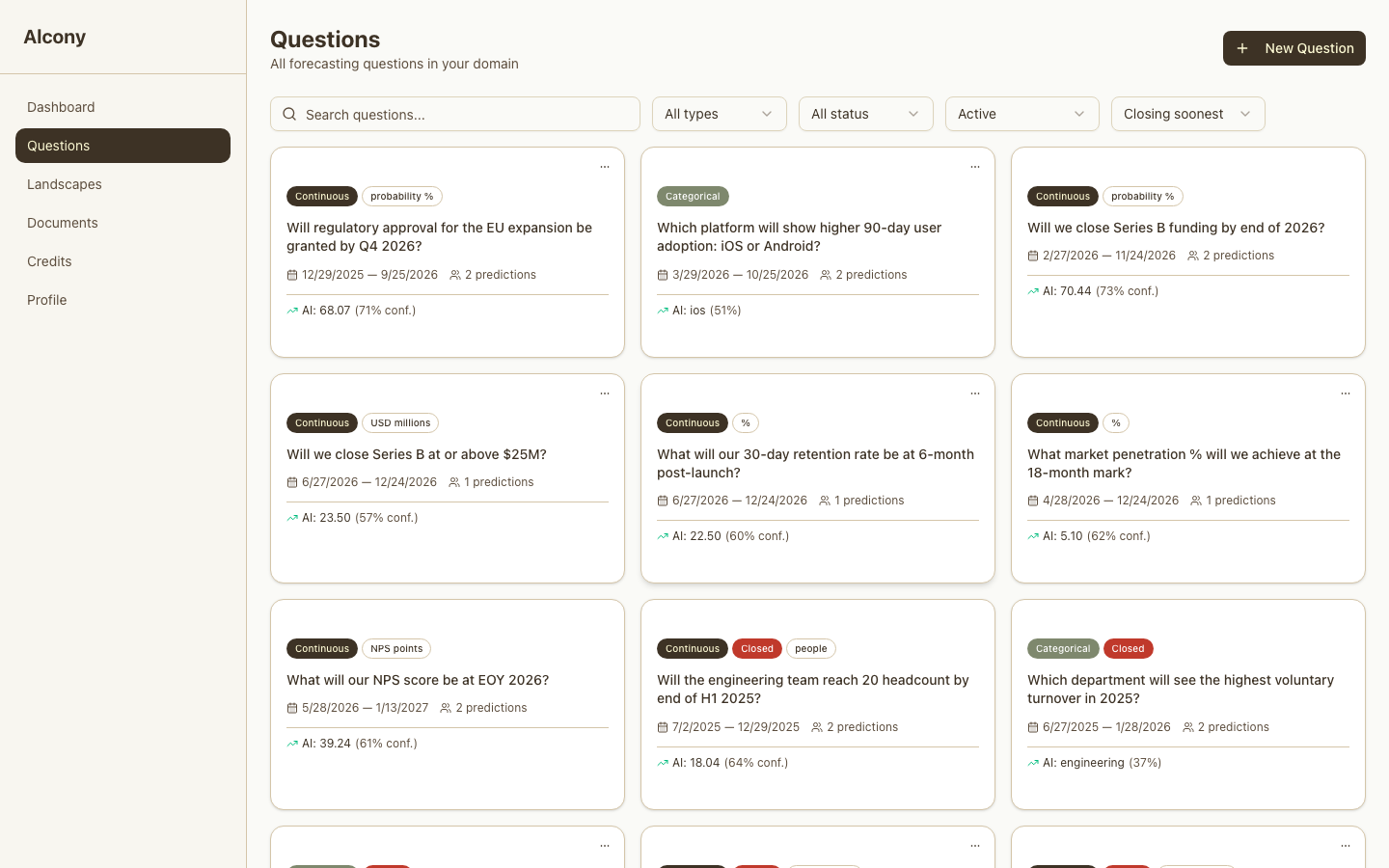
The badge shows type — Continuous (a number), Categorical (multiple choice).
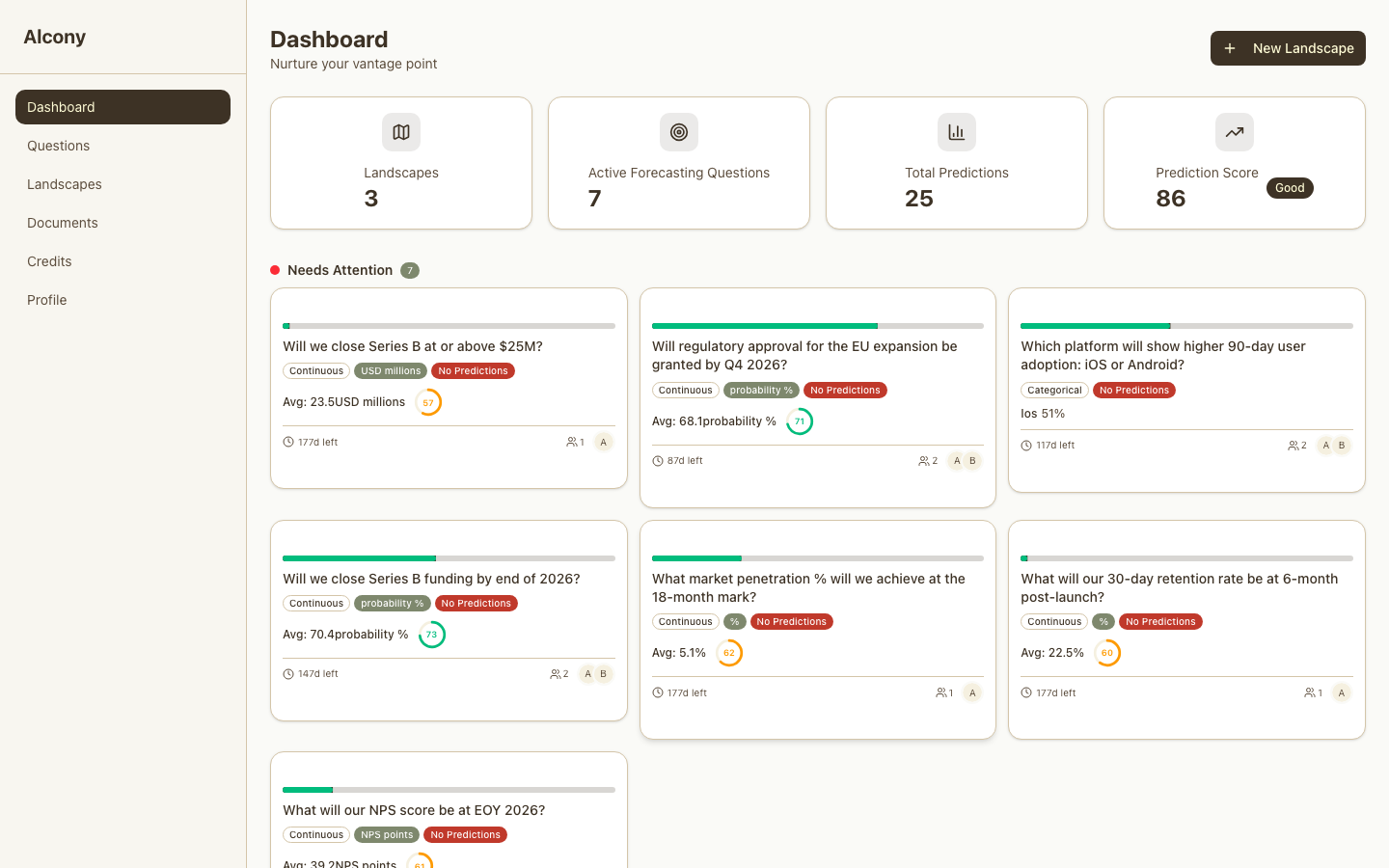
The thin bar across the top of a dashboard card shows time elapsed, not answer quality:
green means more than 7 days left, amber means 3 to 7
days left, red means 3 or fewer days left.
A Closed badge means the question has resolved.
Your Dashboard, with cards grouped by urgency.Red "Closed" badges mark resolved questions in list view.
Your Dashboard groups questions into three sections
Needs Attention
Needs focus — it either needs more predictors (the power of crowds), has low confidence, or is coming up soon.
Monitoring
Active, not urgent — it's working; keep track and update as needed.
Completed
The question has resolved.
Make and Update a Prediction
Goal: record what you currently believe, and update it as things change.
Open a question, click Make Prediction (or Update Prediction if you already have one).
Enter your estimate — a probability, a number, or a category, depending on the question type.
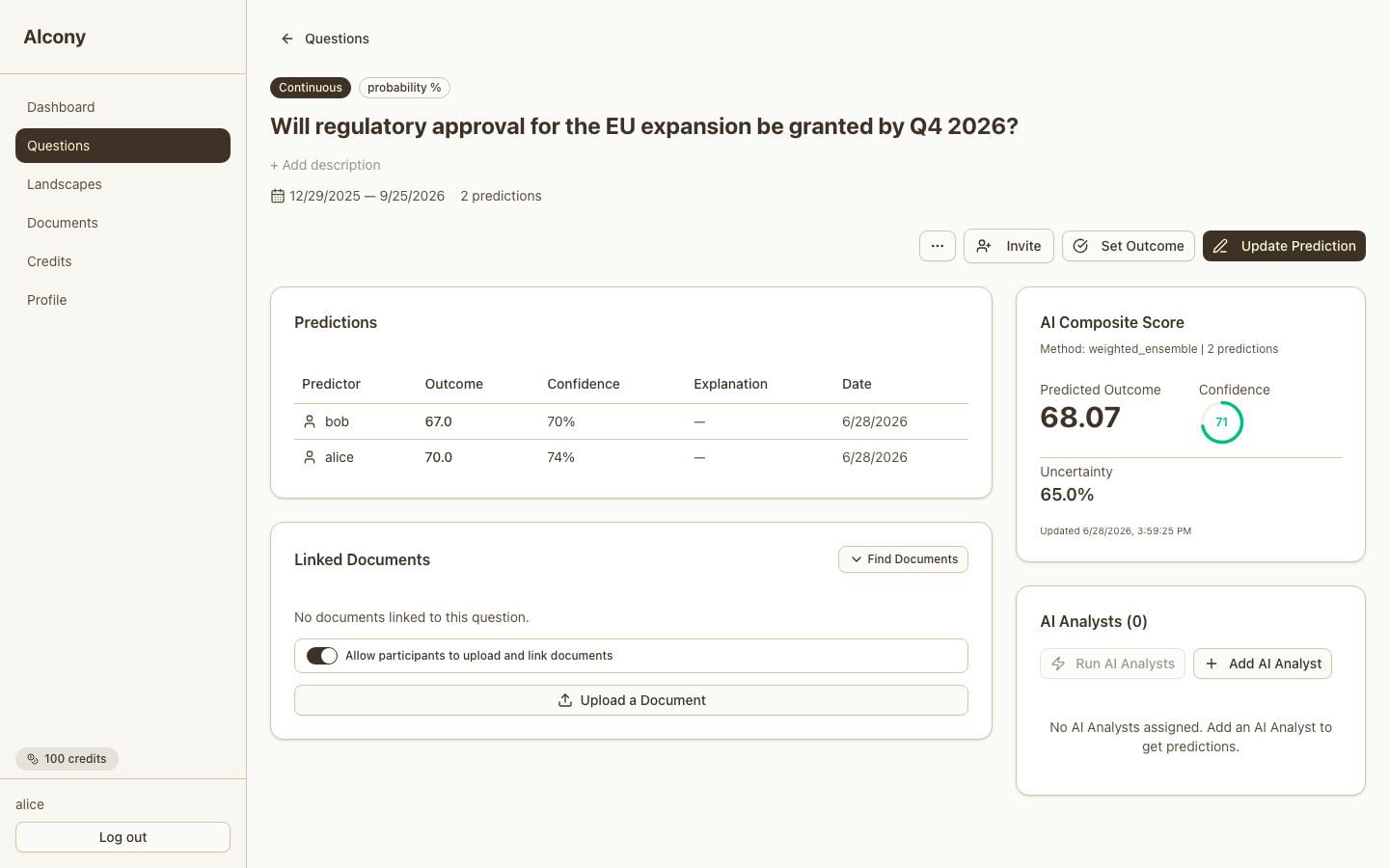
Every prediction you and others make shows up in the Predictions table
(Predictor, Outcome, Confidence, Explanation, Date) — human and AI Analyst predictions
sit side by side.
The AI Composite Score panel next to the table shows the aggregated
view across everyone who's predicted, plus an uncertainty percentage.
The Predictions table, alongside the AI Composite Score panel.
Revisit a question whenever something changes: new information, a closer deadline, or a
friend or AI Analyst disagreeing with you.
Invite a Collaborator
Goal: bring in another perspective without it feeling like "share this app."
Open the question and click Invite.
Your invitee gets that specific question to predict on — and they offer their view
before seeing anyone else's, which keeps the comparison honest.
Optionally let collaborators upload their own documents to the question, via a toggle
on the question page.
Good invite message
"I am trying to think this through on Alcony and would really value your perspective.
Could you add your view to this question?"
Good people to invite
Friends who know the situation and will be honest with you.
People with lived experience or domain expertise.
Collaborators who care about the outcome of the landscape.
Collaborator invites draw from the same 30-invite beta budget as everything else — see
Invite People.
Use AI Analysts
Goal: get a structured second (or eighth) opinion, not a magic answer.
On a question, click Add AI Analyst and pick from the roster. Each
analyst approaches the question from a different angle — some map what limits the
outcome, some follow incentives, some watch how beliefs spread, some hunt for the
surprise scenario (see Meet the AI Analysts). Add as
many as you want; toggle each Active or Disabled.
Click Run AI Analysts. The button shows the live credit cost before you
confirm — each enabled analyst costs 1 credit. If your balance is too low, the button
disables itself and tells you so.
Results land as new rows in the same Predictions table as human predictions — no
separate report or chat view. A Recent AI Analyst Runs list shows each
run's status (queued, running, succeeded, failed, refunded).
How to read them
Compare probabilities and reasoning, not just conclusions.
Notice what assumptions each analyst is making.
Only update your own prediction when one actually changes your mind.
Keep your judgment
They are not guarantees or personal advice.
They don't replace your own judgment.
A failed run is refunded automatically.
Meet the AI Analysts
Every analyst looks at the same question but starts from a different place. The best
results come from picking two or three with different viewpoints and comparing
their reasoning. Analysts marked (numbers) answer number questions
with a point estimate; the rest weigh in on yes/no and multiple-choice questions.
The structure of the situation
"What limits what's possible here?"
MECE Analyst — Maps every possible outcome first; won't put numbers on anything until nothing is missing.
SWOT Analyst — Weighs your internal strengths and weaknesses against outside conditions — a great opportunity means little if the weakness column is long.
PESTEL Analyst — Looks for the one or two big outside forces — political, economic, social, legal — that actually decide the outcome.
Porter's Five Forces Analyst — Believes the structure of a market matters more than any one player's effort; asks who really holds the power.
3 C's Analyst — Checks whether you, your customers, and your competition actually line up; a plan that ignores the competitor's response is incomplete.
Market Entry Analyst — Barriers first: is there a realistic path in before the window closes? Optimistic sizing doesn't count until the barriers clear.
Profitability Analyst (numbers) — Follows the unit economics; distrusts any financial story that hasn't been broken into price, volume, and cost.
BCG Growth-Share Analyst — Judges a position relative to its market — growing or stalling, leading or trailing — and what that combination usually predicts.
Marketing Mix Analyst — Weakest-link thinker: the weakest part of a go-to-market plan sets the ceiling for the whole thing.
McKinsey 7S Analyst — Organizational friction detector: misalignment between a plan and the people, culture, and systems meant to execute it predicts failure.
Incentives
"Who benefits, and what will they actually do?"
General Incentive Analyst — Ignores what people say they'll do and maps what they're actually rewarded for doing.
Incentive Quantitative Analyst (numbers) — Same lens, but sizes the effect: how much behavior actually changes given the incentives.
Beliefs and stories
"What do people believe, and how is that changing?"
Narrative Analyst — Tracks whether an idea will spread based on how catchy and emotionally charged it is — not how true.
Narrative Quantitative Analyst (numbers) — Estimates how far and how fast a story actually travels, anchored on how similar stories have spread.
Getting people to move together
"Can enough people get on board in time?"
Adoption Analyst — Skeptical that early enthusiasm turns into mainstream uptake; looks for proof that ordinary users, not just enthusiasts, are moving.
Adoption Rate Analyst (numbers) — Puts a number on uptake, disciplined by how fast comparable things have actually spread.
Organizational Behavior Analyst — Assumes organizations resist change by default; asks who informally holds veto power and who benefits from the status quo.
Leadership Analyst — Asks whether people follow this leader voluntarily or just comply — and whether the plan depends on one person staying.
Timing and change
"How does this play out over time?"
Three Horizons Analyst — Separates short-term shocks from slow structural shifts, and names which one actually drives your question's window.
Scenario Matrix Analyst — Maps the handful of futures that matter and names the trigger event that would tip you from one to another.
Adaptation Rate Analyst (numbers) — Realistic about speed: systems usually change at their historical pace unless something specific accelerates them.
Human bias
"Where will people — including you — predictably misjudge this?"
General Behavioral Analyst — Audits which biases are active in the situation: fear of loss, following the crowd, wishful timing.
Behavioral Quantitative Analyst (numbers) — Estimates how large those bias effects actually are, anchored on published research.
World events
"How do politics and global forces bear on this?"
Geopolitical PESTEL Analyst — Treats political will as the deciding variable; economics and law mostly constrain what leaders can do.
Country Risk Analyst — Trusts a country's fundamentals — debt, institutions, unrest — over official statements and diplomatic signals.
Geopolitical Alpha Analyst (numbers) — Asks what markets have already priced in, and what shock they're underestimating.
Surprises
"What unlikely event would change everything?"
General Tail Risk Analyst — Hunts for the scenarios that would prove the consensus wrong, and makes sure none is quietly rounded down to zero.
The generalists
"How do situations like this usually turn out?"
General Categorical Analyst — Starts from base rates — how often things like this happen — before adjusting for your specifics.
General Quantitative Analyst (numbers) — Anchors on historical ranges and distrusts extrapolating recent extremes.
When analysts disagree, that's the point. Different viewpoints surface
different assumptions. Compare the reasoning, check the assumptions against your
situation, and keep your own judgment. Multiple predictions from different viewpoints make
the overall composit score better.
Set an Outcome
Goal: close the loop once you know what actually happened.
Open the question once you know the answer (it doesn't have to have hit its end date).
Click Set Outcome, choose the real result.
The question moves to Closed / Completed, and your score updates based on how your
predictions tracked the eventual outcome.
Add Context: Documents
Goal: ground a question or landscape in real information instead of memory.
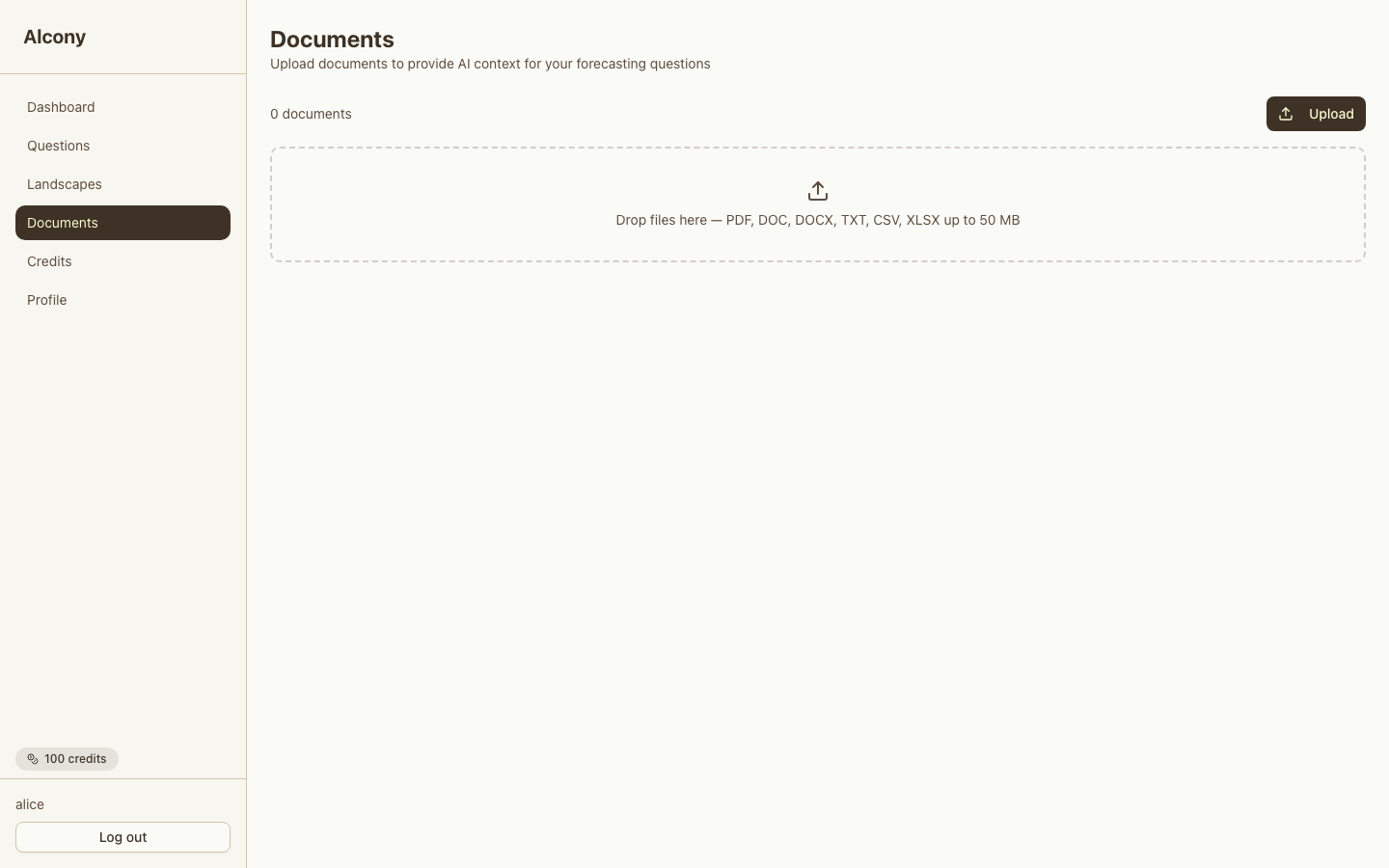
Go to Documents and drag a file in, or click to pick one — PDF, DOC,
DOCX, TXT, CSV, or XLSX, up to 50MB.
Each file shows a status badge — Queued → Processing → Ready (or Failed) — that updates
on its own every few seconds.
From a question page, use Find Documents to link an existing file, or
Upload a Document to add one directly. A question can also allow
invited collaborators to upload their own documents, via a toggle on the question page.
The Documents library, with the upload dropzone and accepted file types.
Invite People
Goal: invite friends to Alcony and share what you're working on.
Give someone read access to a whole landscape, from the landscape's Share button.
Referral link
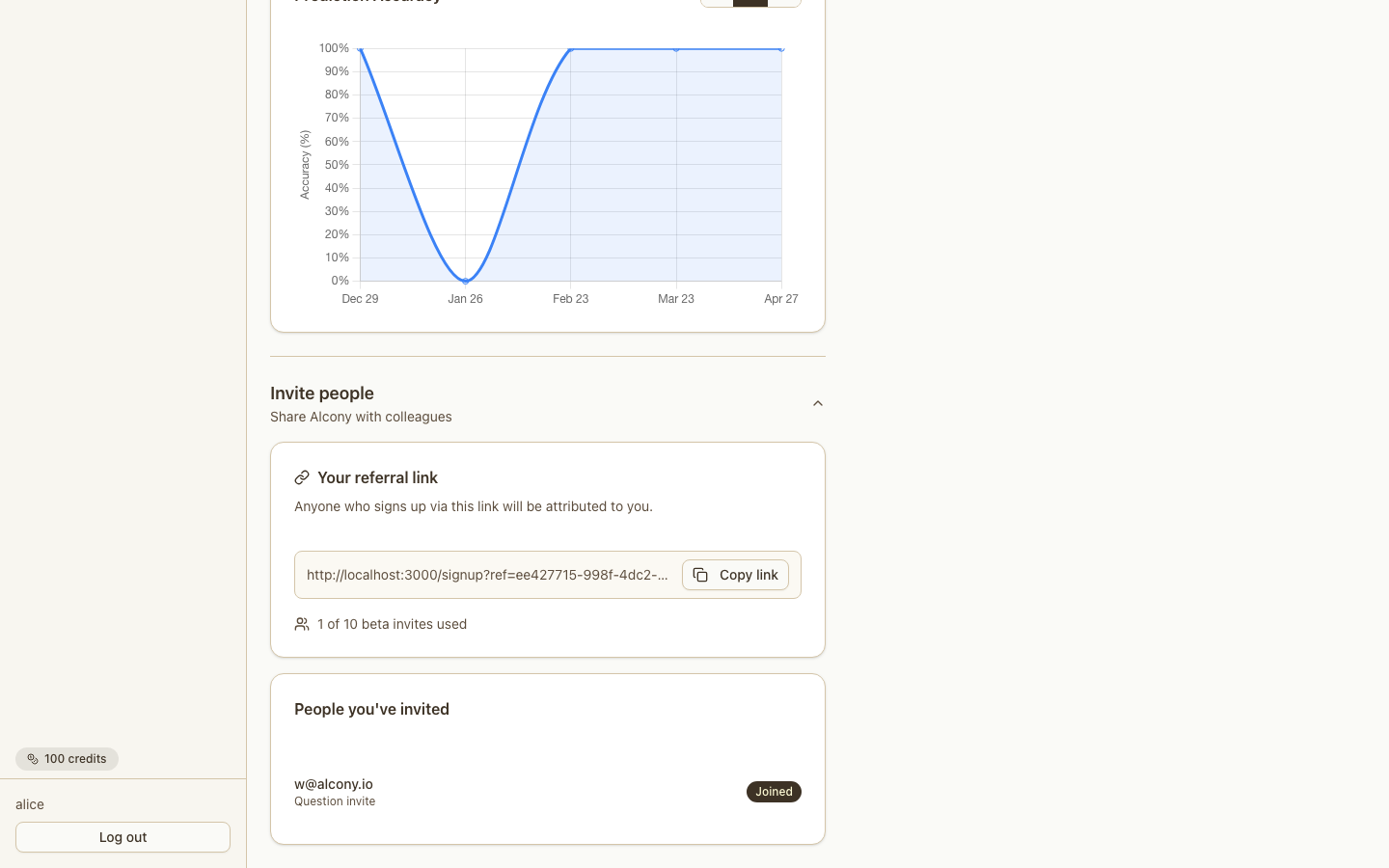
Invite someone to join Alcony itself, from Profile → Invite people.
All three draw from the same capped quota — beta accounts get 30 accepted invites total,
shown as "X of 30 beta invites used." Once that's hit, sending more requires a
support-side limit increase; there's no in-app way around it.
The Profile → Invite people referral flow.
Track Credits
Goal: understand what's costing you credits and how many you have left.
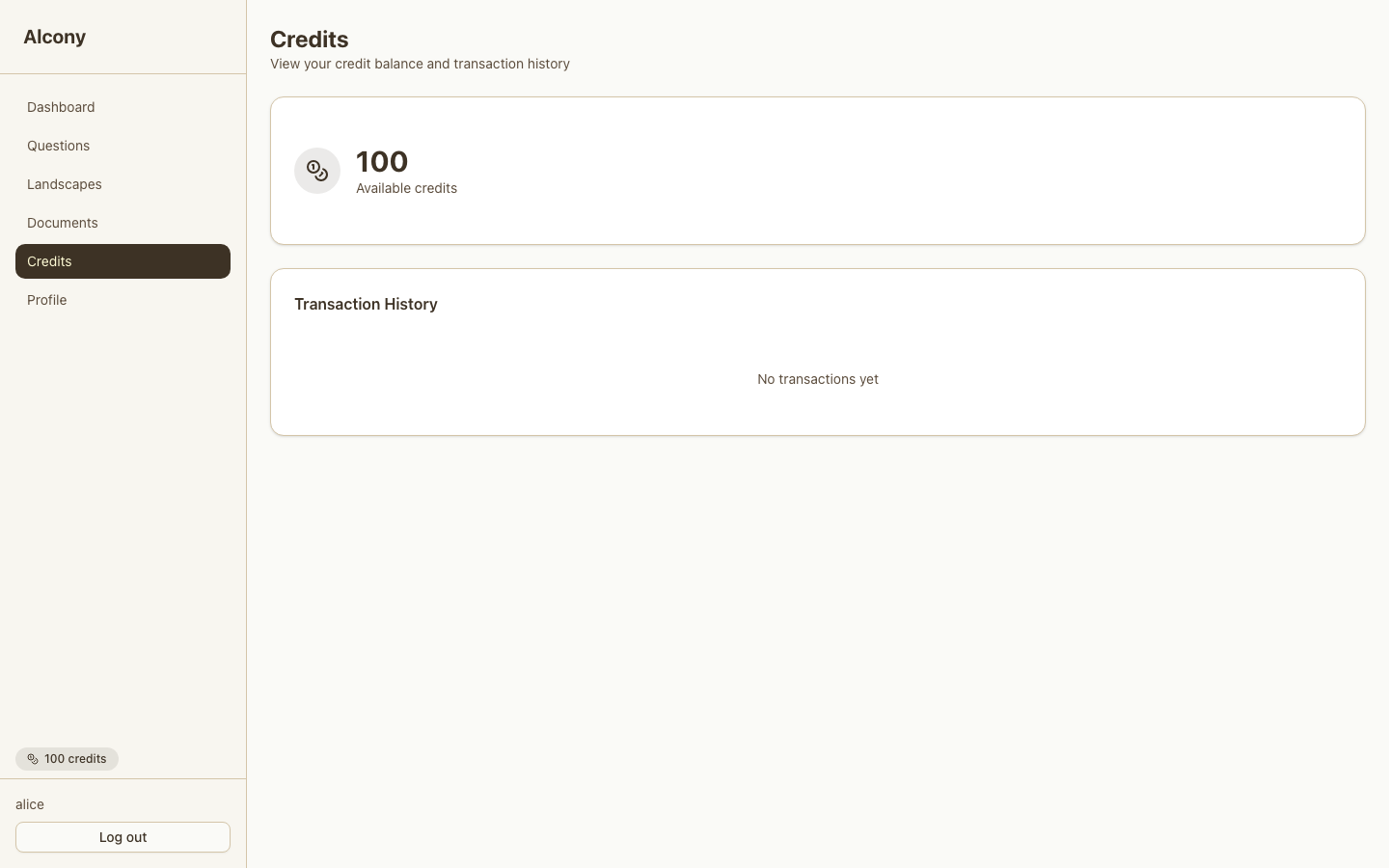
Credits shows your live balance plus a transaction history (Welcome Credits, AI Prediction, Refund, Admin Grant).
The only thing that spends credits today is running an AI Analyst (1 credit per analyst
run). Everything else — creating landscapes/questions, making your own predictions,
uploading documents — is free.
There's no in-app way to buy more credits during beta — but we're also not charging
for them. You'll get monthly refreshes.
Your Credits balance and transaction history.
Cost & Pricing
Early Beta use is free of charge. Thank you for helping us. If you need a refresh, please contact us and we will provide additional credits.
Goal: know how pricing works, so costs is not a surprise.
Alcony runs on a credit system: AI Analyst runs and research refreshes (upcoming feature)
cost credits. Creating landscapes and questions, making your own predictions, and
uploading documents stay free. Our subscription tiers:
Free
$0/mo — 100 one-time credits, only expires if your account closes.
Pro
$8/mo — 250 credits, refreshed monthly.
Power
$20/mo — 800 credits, refreshed monthly.
Need more without changing your subscription? À la carte credit bundles ($5, $10, $20)
never expire and top up any plan.
Pricing is still being finalized and may change before general
availability. Currently pricing starts at pennies per credit. See Track Credits for how your current, free
balance works today.
Quickstart: Create Your First Landscape
1
Start with a real situation
Good first landscapes are active and personal: a stock or crypto position, a
career move, apartment renewal, side project, health habit, purchase, or family
decision.
2
Tell your AI Analyst what terrain you are watching
You can start messy: "Should I hold this position or take profit?", "Should I
stay in my job?", or "Should I move?" Your AI Analyst turns that into a clearer
landscape.
3
Review the action paths and forecasting questions
Your AI Analyst proposes action paths and the forecasting questions that reveal
the shape of the landscape. Keep what is useful and adjust what is not.
4
Create the landscape
You now have a usable map: broad situation, action paths, forecastable questions,
and the connections between them.
5
Make predictions to bring the landscape to life
Predictions are how the landscape starts moving. Add your estimate, run AI
Analysts, or invite someone you trust to offer their view.
A real-world walkthrough of tracking a prediction market position in Alcony, start
to finish.
Common Questions
Why should I start with a landscape?
A landscape gets you above the details before you make predictions. If your
starting point sounds like "What should I do?", "Should I stay or leave?", or "How
should I think about this?", create a landscape. Start with a standalone
question only when you already have a narrow "Will X happen by Y date?" uncertainty.
Do I need to know forecasting before I start?
No — describe your situation normally; Alcony turns it into questions and
predictions.
Can friends see my prediction before making their own?
Invited predictors should offer their view before seeing others', to keep the
comparison honest.
What should I do when AI Analysts disagree?
This is good — you want different opinions. AI Analysts all approach questions from a
specific angle. Treat disagreement as a prompt to check assumptions, not a vote to
settle by picking the most confident one.